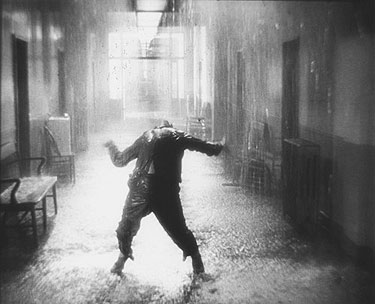
Whatever Works (Allen, 2009)
Coasting. Laziness. Echoes of echoes. And yet, one of his better films of the last decade. Credit this to Larry David, who spins a wonderfully vitriolic variation on the familiar Allen gripes. But let's not dwell on the film's third-act contrivances. There's playing loose with plot, and then there's outright insult to your viewer's intelligence.
A Nos Amours (Pialat, 1983)
"Devastating", as the cliche runs, but it's earned. And what's more, the film lingers and nibbles at you. As debuts in modern cinema goes, Bonnaire's is one of the greats. Also, it's one of the best films I've ever seen about the listlessness at the heart of so much "desire" - think of it as a warm-blooded, non-didactic version of Bresson's The Devil, Probably. Susan and I have more Pialat planned - um, "stay tuned"?
Silence of The Lambs (Demme, 1991)
Hadn't seen it since I was 18, in an edited TV format, and became curious again after reading some of the Harris source material. Was surprised at its strengths - Foster's exceptional performance, and Demme's wonderfully subjective camera strategies in the film's first half. Once it turns into an outright thriller things grow quickly wearisome, but nonetheless, so much stronger than I'd remembered / comprehended as a dumbass kid.
Aliens (Cameron, 1986) / The Abyss (Cameron, 1989)
Blame it on Avatar excitement, which had me scuttling for yet more revisiting of teenage memories. These are even stronger - I've probably seen Aliens three or four times, yet even my as-established junior self couldn't have comprehended what a masterpiece this film is. It's a machine, slow-burning, with a credibly (spatially, psychologically) established first act leading up to one of the most brilliantly sustained last hour's in "action" cinema. Though, as you can tell by the quotes, that dimwit genre doesn't deserve it (nor is sci-fi a neat fit here). Still, the film has the momentum of a boulder descending a mountain. Astonishing. As for The Abyss, it's my Cameron fear writ-large - sentimentality killing off awesomely impersonal technological gifts. This is the first film he got truly goopy on us, leading to the dead-end of Titanic. The underwater footage and sustained compressed atmosphere is all brilliantly done, and has not dated in the slightest. Everything else leaves me very cold two decades later. File Under: The Perils and Payoffs of Nostalgia.
Moon (Jones, 2009)
A couple of weeks later, all that lasts beyond the borrowed Kubrickisms and weak third act is Sam Rockwell's performance. He's wonderful, and needs to be - this thing's a chamber piece, and I found the scenario around Rockwell fairly tired and familiar. But he's good - it's the sort of performance would should a bunch of awards, for what it's worth.
Shock Corridor (Fuller, 1963)
Possibly Fuller's best - his crassness and hectoring having found the perfect subject matter, he proceeds to ratchet up the personal melodrama and treat Stanley Kramer social issues with the tact of a drunken uncle. Your reactions to it veer from laughter to shock from scene to scene, never certain if it's a patronising laugh or a laugh of sympathy. And Cortez's cinematography turns the whole starker and more lurid still. Wonderful.
White Dog (Fuller, 1982)
The whole thing should collapse under its clumsiness and heavy-handedness, yet nonetheless there's a curiously poignant quality to the film that sails right by anything as stock as "ideas". Once that dog goes wild and Fuller responds by rhapsodising in slow motion, whatever message you care to chew over later in the lobby becomes a solely physical, irrational force, way beyond speechifying. And a great closing shot too.
Hypothesis of A Stolen Painting (Ruiz, 1979)
I was tired, and should have called it quits there. But instead I've now got this cinematic puzzle (far too easy to call it a filmed Borges short, but what else can you honestly come up with foolish brain!) making me feel exceptionally slow off the mark. Often referred to as a good entry point to Ruiz's daunting (in so many ways) body of work, I wouldn't recommend it personally - it's archness without laughter, play without joy. Other Ruiz films as an undergraduate charmed me greatly, though they exist for me now as mere fragments. File Under: My Head Hurts.
The Smiling Lieutenant (Lubitsch, 1931)
Wonderful piffle, in a way which seems so beyond our current filmmakers abilities and so removed from our own sensibilities as viewers as to qualify as some kind of semi-masterpiece. I mean really, it's the art of no-art, the illusion of ease. The view of marriage is puzzling at best. I found Maurice Chevalier to be quite charming after some initial hesitations. There's a great song about lingerie near the end. Duck Soup makes more sense now. Bring on Monte Carlo!
Paris Nous Appartient (Rivette, 1960)
My first Rivette - a sprawling, dense, piece-together pit of cinephile paranoia that seems to demand a replay the second you're done with it. After all the hype and expectation, it didn't disappoint. However, I have no idea how to approach it just now, and need more time wandering through Jacques' lengthy cine-world. I have Celine and Julie Go Boating ready to go. File Under: Continuing Research.
Tetsuo (Tsukamoto, 1989)
I actually recommended this to a guy I work with - that'll be the last time he turns to me for film suggestions. However, if you for some reason take my word as cine-bible, can I recommend you track down this demented piece of possibly-subtext laden insanity and enjoy it solely on a visual level (oh the naivety!), paying special attention to the disruptive editing and mixed-media thrills and spills. A drink or three beforehand will not hurt your enjoyment.
New York Ripper (Fulci, 1982)
I don't trust you Lucio Fulci. Your cult status is, well, undeserved. Sure, you deliver some graphic kills (ah those fanboy favourites), and that fight with the shark and the zombie underwater in Zombie 2/Zombie Holocaust never fails to amuse, but is that really enough to hang your reputation on? I've never found your highly regarded The Beyond scary - silly and overblown yes, but never disquieting or crassly effective as it should be. As for this film, your most "notorious" effort, well, it can go right back to amusing dipshit teenage nihilists and AICN readers as far as I'm concerned. It's dreck, and maybe the old me would give you some leeway, but now it plays worse than ever. Then again, I hear your earlier efforts like A Lizard In A Woman's Skin and Don't Torture A Duckling are quite special, and less beholden to tired giallo tropes. So maybe later.
Julie and Julia (Ephron, 2009)
A Nora Ephron movie? I'm there. I'm there in the same way that that I'm there for any slop Woody Allen wants to serve up. But when I hand over my $16.50 to see Whatever Works what I'm really doing is paying off a debt I owe on Annie Hall and at least a dozen other films that give me joy until this day, and that's ok. With Ephron, though, it's different. She's written (not directed) only one great Rom Com - When Harry Met Sally... (Reiner, 1989), but her parents wrote Desk Set (Lang, 1957) so all is forgiven. Women's porn, basically: food, frocks, French scenery, women friends with the wit of Dorothy Parker, men friends who understand beyond all understanding - and that feeling of having been cheated somehow. It made me want to cook, but it made me want to own Julia Child's cookbook more. In other words, it made a 1950s housewife out of me. Can't be good.


